WHAT I READ THIS WEEK
The power went out all the time in Kosovo, and one night it cut out in the middle of a Skype call home, right after a game where I fouled out and twisted my knee. I sat in that dark apartment for hours next to a refrigerator that was getting warmer by the minute, and somewhere in there I decided I was done with basketball. I signed for another season anyway. When I wrote about it in Overseas Famous, the best explanation I could come up with was that my ego got in the way, because I didn't know any other life besides being a basketball player and every one of my friends back home had normal jobs. By the time I played my last game in Estonia, swallowing 1200 mg of ibuprofen just to get my knee onto the court, retiring felt a lot more like relief than heartbreak.
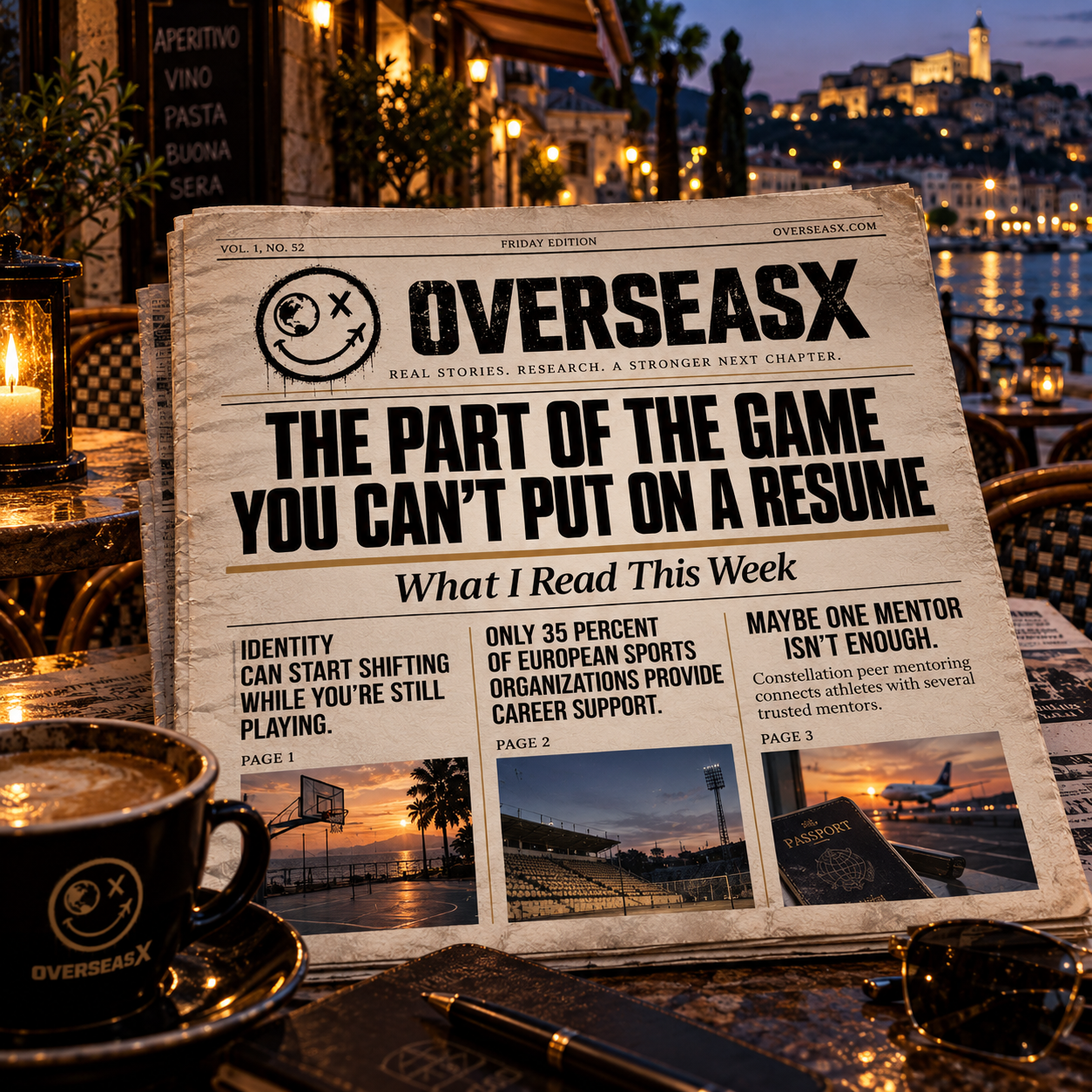
I thought about that dark apartment a lot this week, because I read three pieces that ended up connecting even though each one was about something different. One looked at what happens to an athlete's identity while they are still playing. Another looked at whether the organizations responsible for elite athletes are doing much of anything to get them ready for life afterward. The third made me rethink the way we talk about mentorship, like every athlete is supposed to get assigned one wise old person who has the answers to every problem they will ever have.
The first one just came out on September 22 in the Journal of Applied Sport Psychology. Researchers followed Swiss national team athletes for two years, starting with 559 of them and analyzing 554 after tossing out five statistical outliers. In 2022 they measured athletic identity, physical health, psychological health and social support, and then in 2024 they came back to see who was still competing and who had retired, which turned out to be ninety six people.
The number I couldn't stop thinking about was 2.71, because athletes in the group with below average athletic identity had 2.71 times the odds of retiring during those two years compared with the other groups, while athletes with above average athletic identity had about half the odds.
Now, before I turn into the guy who reads one study and starts diagnosing everybody in the locker room, I should say the researchers are careful here. They are looking at associations between different career resources and whether athletes kept going or stopped, so nobody can say from this that losing your athletic identity makes you retire. They also point out something I found pretty interesting, which is that a weaker athletic identity could sometimes be part of healthy preparation for whatever comes next.
That sent my brain right back to Kosovo. I always thought of retirement as the moment you stop playing, with a last team, a last game, a last contract and eventually some August where you have to admit nobody is calling anymore. (I spent the fall of 2009 doing exactly that, sitting at home writing a blog called Waiting for Godunk while I waited for my agent to call.) Looking back, I wonder how often retirement starts a lot earlier than any of that.
There is this strange stretch late in a career where you are absolutely still a professional athlete. You practice, play games and somebody pays you to do it, and everybody around you still sees a basketball player when you awkwardly duck through the doorway…but your relationship with the game is already changing. I can recognize that feeling much easier now than I could when I was living it. At the time, I would have told you I was tired of the grind, or pissed about all the waiting on someone else’s decision about me, or sick of moving or wondering how many more years I wanted to keep doing this. I definitely wasn't sitting in my apartment thinking, Interesting, perhaps my athletic identity is beginning to evolve. I was probably wondering why the fucking WiFi stopped working again, or in Kosovo's case, why the entire country's water got shut off at 11 pm while I was standing in the shower with a head full of shampoo.
That matters because professional athletes are trained to read almost any thought about stopping as weakness. You spent your whole life trying to get there, and then you fought every single year to stay there. Overseas makes it even stranger, because so much of the career is built around chasing the next opportunity, and you finish one season and almost immediately start wondering where the next contract is coming from. Admitting that basketball doesn't feel the way it used to can feel like betraying the thing you spent your entire life becoming, which is probably why I kept telling my agent to keep looking.
The study doesn't prove any of that was going on with these athletes, and that part is my interpretation. What it did make me question is why we wait until somebody announces their retirement to start talking seriously about transition, when that conversation could start while they're still playing.
Read the Swiss elite athlete study
THEN I STARTED LOOKING AT WHO IS SUPPOSED TO HELP
I’ve talked about this on here before, as the data is pretty ridiculous. Researchers reached out to 27 major European sports organizations, mostly National Olympic Committees, and asked about the mental health and career support they give elite athletes. Seventeen of them responded, and what came back was a pretty uneven system that depends a lot on where an athlete happens to be from.
Only 35 percent of the countries that responded said they currently provide career transition services, another 35 percent said those services were being developed, and 30 percent had nothing at all. Even in the countries that do provide help, things like job placement, financial planning and networking showed up a lot less often than educational workshops, and only 3.2 percent of the career transition services they reported involved any kind of monitoring or follow up.
That 3.2 percent is annoying as hell. You can put an athlete through a workshop and technically say you provided career transition education, and everybody checks the stupid box, takes the picture and goes home. Brochures are great at promising things. The one my agent emailed me before my first exposure camp promised EXPOSURE in capital letters, and I ended up exposed to a whole lot more. So did anybody call that athlete six months after the workshop and check if they got a job or if they are doing something they want to do? Did anything from that workshop make sense once they were sitting at home with no practice to go to the next morning? It reminds me how far apart providing a resource and helping a person can be.
And again, these services were mostly being offered to athletes who had won medals in international competition, and the researchers found that funding problems were hurting how sustainable and how good the services were. I understand limited resources, since every organization has a budget, but athlete transition is a strange place to decide that the people who achieved the most should automatically get the most help.
Overseas basketball makes that especially obvious, because our careers don't fit neatly into any system like that. You can bounce from league to league for your entire career and never have one organization responsible for you long enough to think about what happens when you're finished. Your team cares about this season, your next team cares about next season, your agent needs another contract, and everybody is understandably focused on keeping the basketball part moving. When my knee blew out in Korea, Mobis Phoebus put me on a plane home and then emailed my agent that it wasn't their responsibility, so I rehabbed in my parents' attic and paid for my own medical care. Nobody in that chain was thinking about Kevin at 35, and to be perfectly fucking honest, nobody in that chain was thinking about Kevin at 28 either.
Which is why athlete support has to travel with the athlete wherever they go, the same way my suitcase full of ankle braces, tape and 47 bottles of ibuprofen did. Otherwise you can have an entire professional career surrounded by basketball organizations and reach the end without one of them ever being responsible for getting you ready for what comes next.
Read the European athlete support study
MAYBE ONE MENTOR ISN'T THE ANSWER EITHER
Brennan Petersen and Robert Schinke published a paper this year in The Sport Psychologist about something called constellation peer mentoring, which is the kind of name I would have skipped right past if I saw it in a research journal. The idea is simple…give somebody several mentors at once. The authors describe a model where a less experienced athlete regularly interacts with multiple experienced mentors, so different people bring different perspectives, which can build stronger social support and make athletes more comfortable asking for help, particularly around mental health. It builds on earlier work with Canadian university athletes, where constellation mentoring was associated with better help seeking, stronger team cohesion and less transition stress.
That makes a shitload of sense to me. We've made mentorship sound like you need to go find your basketball Yoda, one person who understands contracts, money, marriage, mental health, business, retirement and whatever else happens to you between 22 and 42. Good fucking luck finding that person, because I never did.
When I look back, I had a constellation and just didn't know to call it that. Coach Crawford is the reason I was coachable, which an AAU coach later named as my greatest strength in front of the whole team. Chucky Brown taught me how to use my forearms to get position on the glass. Mikki Moore told me I couldn't play every minute at Ludicrous Speed or I would burn myself out, and Cory Alexander showed all of us how to handle the press and carry ourselves like pros. Josh Asselin taught me his spin move by using it on me roughly 276 times. Kent Davison told me to find the one thing I was good at and be the best at it, which for me was rebounding. And my brother Geoff, who once knocked me through the drywall during a game of Nerf basketball, talked me out of retiring at a café in Mulhouse when all I wanted to do was day drink and eat crepes. Not one of those people could have handled all of it.
Think about an overseas player today. Maybe you're 24 and your team hasn't paid you in two months, so you need somebody who understands contracts and has been through nonpayment. (I was 25 in Poland when a woman walked into the owner's office with a bag of hundreds and counted out $3,000 as a formal goodbye.) Six months later you're deciding whether to fire your agent, which is a whole other conversation. A few years later, you're married with kids and wondering how much longer it makes sense to drag everybody across the world. Then eventually basketball ends and you have to figure out how ten years of professional basketball translates into a completely different career. Why would the same person automatically be the best one for every one of those conversations?
That's what I like about the idea of a constellation. What an athlete needs is people, plural, and those people don't all need to be former players. Lived experience matters a ton, especially with something as fucking bizzare as overseas basketball, and there are moments when talking to somebody who has been cut, stiffed on money, moved countries overnight or sat at home in August waiting for the phone to ring saves you twenty minutes of explaining why you're losing your mind. There are other moments where the right person is a financial professional, a therapist, an attorney, a business owner or somebody working in the industry you're trying to get into. What matters is having enough trusted people around you that when something happens, you know who makes sense to call, which is a lot more than handing an athlete one mentor's phone number and announcing that the mentorship box has been checked.
Read the constellation mentoring paper details
WHAT I TOOK FROM ALL THREE
Reading these together changed the question I've been asking. We've spent a lot of time talking about how to help athletes after sports, and I'm becoming more convinced that if we wait until after sports, we're already late. An athlete's relationship with the game can start changing while they’re still playing. The Swiss research gives us evidence that athletic identity and career continuation are connected, even though it can't tell us which one is driving the other. The European research shows how inconsistent formal career support still is, and the mentoring work gives us a whole different way to think about the people surrounding an athlete long before they ever get to retirement.
For me, that's where OverseasX fits…I don't want somebody joining this community for the first time at 35, when basketball is over and they're sitting at home wondering what the fuck happened. I want the 26 year old who loves basketball and plans on playing another ten years to be here too. Build relationships now, talk to people outside your little basketball bubble now, learn about money now, and meet people working in industries that interest you now. And if something feels different about basketball one year, it would be nice to have somebody you trust enough to talk about it with, without anybody assuming it means you're quitting.
Nobody should be dragging athletes away from the game while they're still playing. I would have hated that shit in Cairns or Wellington, because basketball deserved my attention, it was my job and I loved doing it. You can love the game with everything you have and still pick up the phone when somebody in the community who works in finance offers to grab a coffee.
The more of this research I read, the more I think good transition work probably doesn't feel like transition work while you're doing it. It feels like relationships and conversations and meeting people and learning how the world outside your sport works while you still have the security of being inside it, so that whenever that last season comes, you aren't standing there trying to build an entire fucking life from zero.
I constantly go back to a conversation I had with a former teammate who had just gotten back from Germany. I asked him what his plan was, and he wrote back, "KO, I have no fucking clue!" I'd love for fewer of us to be sending that text.
If you're already part of OverseasX, use the community that way. Reach out to the people and resources we have here, and ask your questions while they're still small questions. If you don't know who you should be talking to, ask us and we'll help connect you. You don't need to know when your career is ending to start getting ready for whenever it does.
With OverseasX, you'll never have to walk this journey alone.