Playing Through Chaos
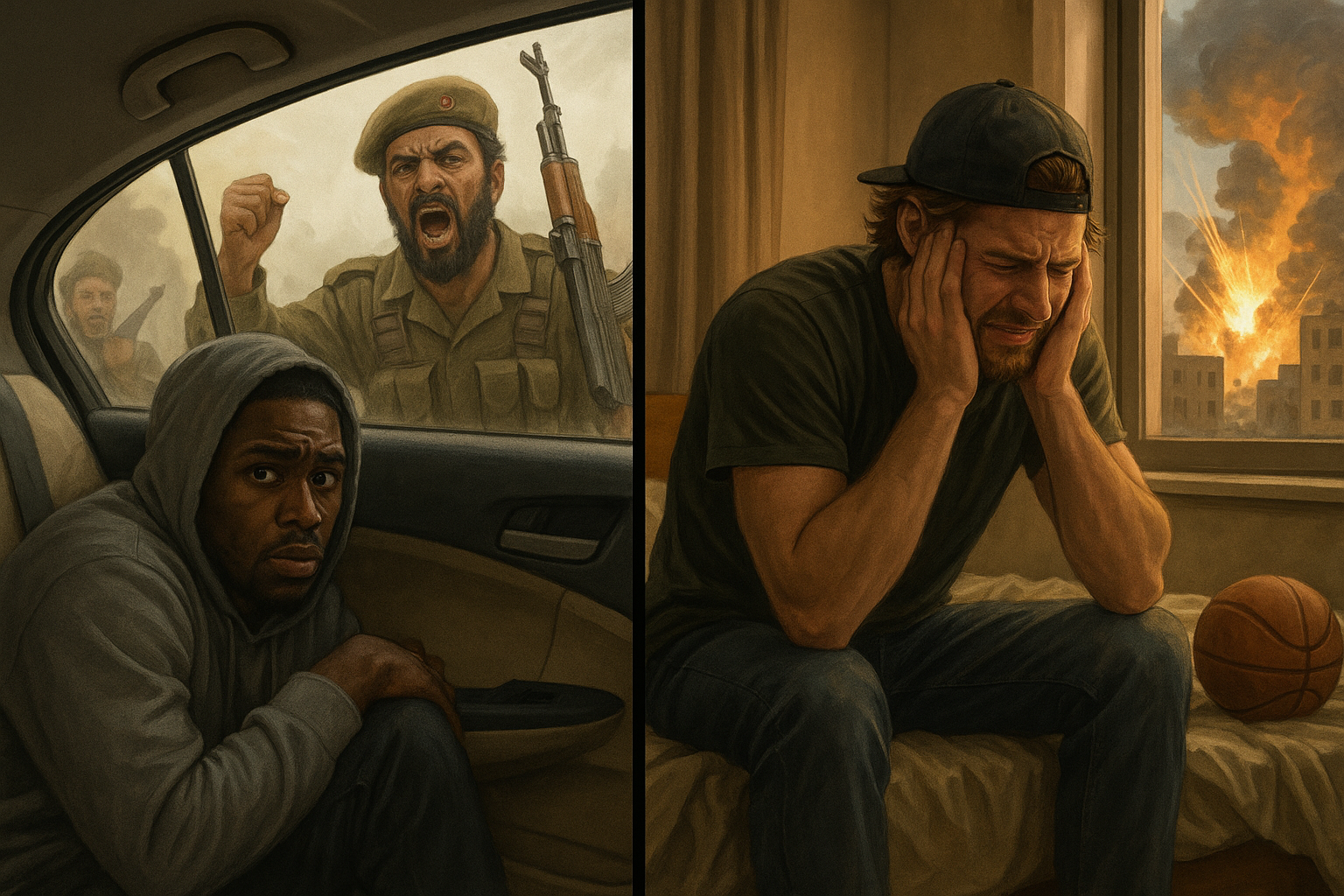
To the outside world overseas basketball looks like late-night kebabs, some cool pics in front of historical landmarks, or some dope highlights in an ad-covered uniform…at least, that’s the version people like to post.
But sometimes overseas basketball means hiding in a crumbling apartment while gunfire echoes outside. No power, no food, no water…and a game that suddenly doesn’t matter at all.
This life doesn’t come with an instruction manual for what to do when the country you’re playing in collapses. And when the world goes sideways, overseas athletes don’t get to hit pause. You still have to suit up and figure it out.
Alex Owumi: Trapped During the Fall of Gaddafi
I had Alex Owumi on the Overseas Famous podcast a while back, and his story has stuck with me ever since.
He signed with Al-Nasr in Libya in late 2010. The team was owned by Muammar Gaddafi’s family. It looked like a dream gig…good money with ocean views.
Then the country erupted.
During the Libyan revolution, Alex found himself trapped in his apartment in Benghazi for weeks with no electricity, no running water and no food.
He was stuck in a war zone. The team vanished. His phone barely worked, while gunfire echoed outside.
He survived on bugs and toilet water…Seriously, that’s not some storytelling dramatic effect. That’s what he actually had to do to stay alive.
Eventually, he was smuggled out of the country, driven across rebel checkpoints, through chaos, into Egypt. And then somehow…he started playing again.
He went on to win a championship in Egypt and was the finals MVP. Just weeks after nearly dying in an apartment with no food.
Basketball Doesn’t Stop for War
That story should’ve been headline news. But like so many overseas athletes, Alex’s experience flew under the radar.
And it’s not the only one like it.
When you play overseas, you are a guest in someone else’s house. That means when the world turns political and shit starts going wrong, your comfort and your safety are all second-tier concerns.
I’ve talked to players who sat through missile sirens, hearing bombs echoing in the distance. Others who navigated through protests in order to get to practice. And plenty of athletes who were locked down during military unrest.
The world keeps spinning. And overseas teams usually don’t cancel games unless a building is actually on fire.
Most of the time, it’s “get to practice, be ready, don’t ask questions.”
The Mental Weight of Playing Through Crisis
What hits the hardest isn’t always the danger. It’s the isolation.
You’re stuck, you don’t speak the language, you don’t know who to trust. The club won’t help and your agent might not be able to reach you.
Back home, everyone’s freaking out, telling you to, ‘Get on a fucking plane right now!’…meanwhile, the team’s telling you to grab more rebounds tonight.
In between practice you’re googling how to cross a border on foot and checking if your passport is still valid. You’re afraid if you post something online, you might piss off the team, the league, or the entire country. So you sit quietly and pretend everything’s fine.
You go to practice. You hit the weight room. You play your 30 minutes.
And then you go home, lock the door, and refresh the news until 3 a.m.
That pressure builds. You play through trauma, then pretend it didn’t affect you.
But it does.
When Your Teammate Is a Soldier
One of the lesser-known facts about overseas basketball is how many countries still require military service.
When I played for Hyundai Mobis Phoebus in South Korea, our star point guard got pulled for duty right before the season started. No warning…just gone. It left a massive hole in the roster. Well…two holes. My knee would create the second a few weeks later setting off a chain of events that would leave me bitter for the rest of my life…but I digress.
The wild thing is how normal this kind of thing is overseas.
I’ve heard stories like this from close friends. Some youth player who was tough as hell and took charges like it was a paycheck. Then one day, he just didn’t show up to practice.
Next morning?
Coach tells them the country was on alert and he was activated. He didn’t even get to say goodbye.
Two weeks later, he came back like nothing happened. Laced up, dropped 15 off the bench, and casually shifted between different versions of ‘attack mode.’
That’s what people don’t understand.
In some countries, basketball isn’t the dream. It’s the break from reality.
What Do You Do With All That?
I didn’t write this to scare people. I wrote it because if you’re going overseas, or if you’ve already been, this part of the story matters just as much as the wins and the stats.
You need to be mentally ready for the unknown. You need to ask the questions no one tells you to ask.
Where’s the embassy?
What’s the political climate?
Can I get out if I need to?
What does the clause in my contract say about war or unrest?
The games are the easy part. It’s everything off the court that wears you down. The travel, the politics. All that unexpected shit no one warns you about.
You figure it out…and survive.
That’s overseas basketball.
Why We Built OverseasX
Stories like Alex’s are why OverseasX exists.
There’s no support system for when real life crashes into your basketball career. No safety net or prep course for war zones.
We’re here to fix that.
OverseasX is the platform built by people who’ve lived it. Not just for job leads, but for support, preparation, community, and survival.
You might never play through a revolution. But someone will. And when they do, they shouldn’t have to go through it alone.
Final Thought
This career takes you places most people will never understand. And sometimes, those places test you more than any defender or coach.
If you’ve got a story or been through something that changed you…please share it.
We built this platform for the athletes who kept going when everything around them fell apart.
You’re not alone.