How NBA Dreams Set the Overseas Market in Motion
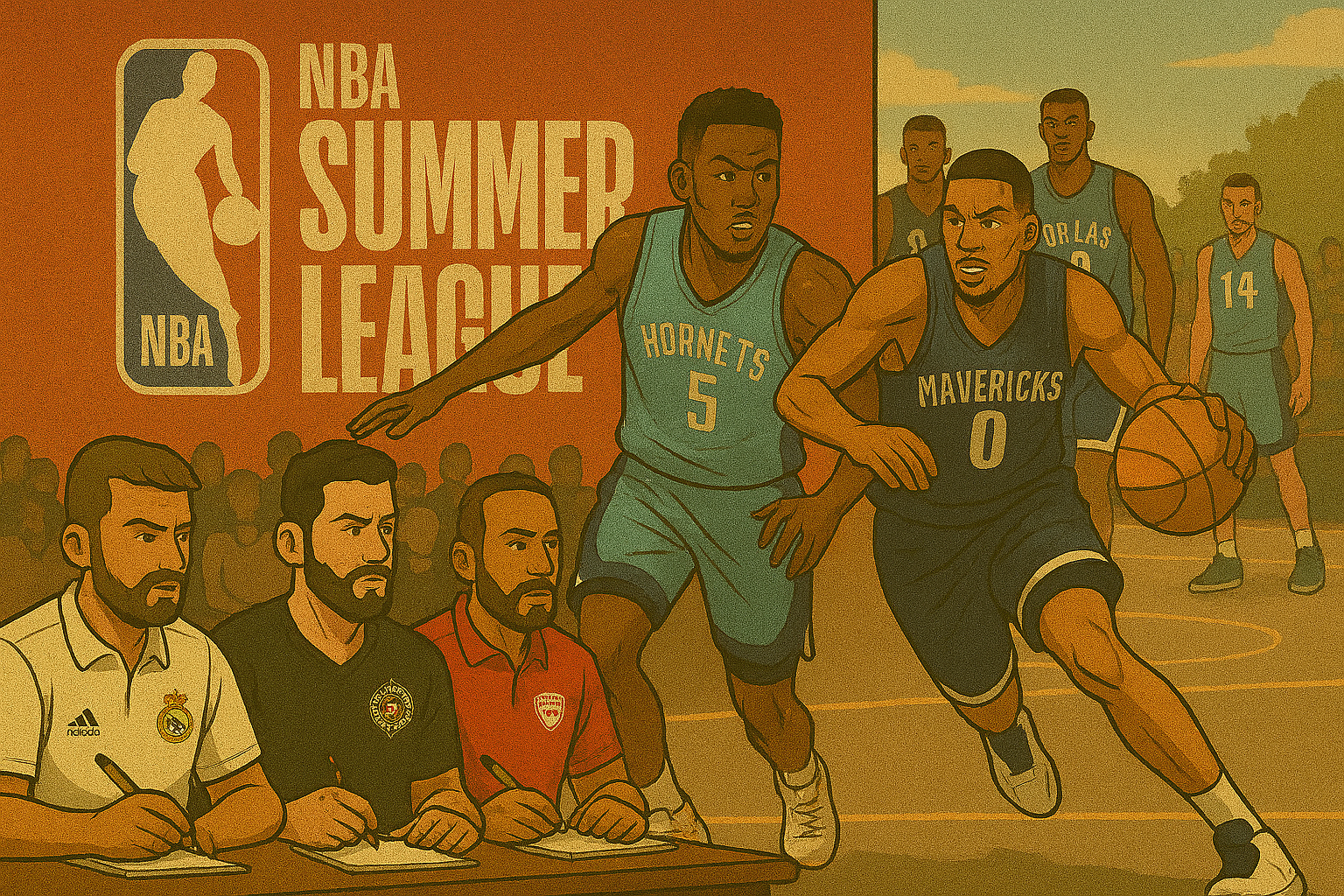
If you’re an NBA blogger or in the business of basketball, the NBA Summer League is a dream. You’ve got articles hyping up some second-round pick like he’s the next great role player, and everyone’s networking trying to kick off Q3 with a bang. But for overseas pros, this is when things actually start moving. Behind all the noise and hype around Summer League standouts, teams across the world are quietly building their rosters. Once Summer League tips off, the entire overseas market starts shifting.
Summer League is step one. Where agents hover courtside like hawks, while scouts from Europe sit three rows behind NBA execs, watching the same players but with totally different intentions. Some are there to evaluate a potential fit for their NBA team, while the others are building their overseas roster…and they’re waiting for the right guy to NOT get a call.
The Real Goal of Summer League
There’s this weird assumption that Summer League is some magical place where, if you play well, immediately you’re in the NBA. But the reality is much different. The actual point of Summer League is to get invited to training camp. That’s it...To play well enough to possibly stick around for preseason.
Each team runs a Summer League roster with about 15 players. Some are first-round picks who already have guaranteed contracts. Some are second-rounders trying to lock in a deal. Most are undrafted free agents with overseas or G-League experience, bouncing around trying to get a foot in the door.
Of those 15? Maybe five will get a shot to attend training camp. And even then, those spots aren’t guarenteed.
During the offseason, NBA teams are allowed to carry up to 20 players. That gives them a chance to fill the back end of the roster with hopefuls like guys on Exhibit 10 contracts or non-guaranteed deals. It’s a numbers game, plain and simple. Every front office is juggling what they have versus what they still need. And that juggling act could make or break an athlete's year.
Exhibit 10s, Two-Ways, and Reality Checks
Let’s break down what most players are signing. You may have heard of Exhibit 10 contracts, but here’s how they actually work:
An Exhibit 10 deal is basically an invite to training camp. It guarantees nothing. You show up, compete, and hope they like you. If they don’t keep you, you get waived and (if you agree) sent to their G League affiliate. If you stay with that affiliate for at least 60 days, you get a bonus, anywhere from $5,000 to $75,000 depending on the deal. So, for some guys, it’s a calculated risk. Stay in the G League, stay in the system, and maybe get called up.
A two-way contract is different. It gives you a real opportunity to go back and forth between the NBA team and the G League. You can be on the NBA roster for up to 50 games. The money’s better and the odds are slightly better too. But again…there are only three of these per team.
So imagine being a free agent in Vegas. You play your ass off in Summer League. Maybe your agent’s phone rings. The team likes you. They offer you an Exhibit 10. Or maybe a two-way. Now you’ve got a choice.
Do you take that deal, hoping it gets you into the league? Or do you turn it down and take a guaranteed six-figure contract overseas?
That’s the decision. That’s the moment where a lot of careers pivot.
The Overseas Scouts Are Watching
While all this is happening and guys are trying to figure out what to do next, there’s a group of overseas scouts who already made up their mind.
They’re in Vegas for one reason…to steal talent.
They know not every guy on that court is going to the league. They also know a lot of those guys don’t want to play in the G League, so they watch with offers in hand.
Once Summer League wraps up, they start making calls.
They’ll go after the top tier players who didn’t get a two-way. Guys who killed it in Vegas but don’t want to grind it out in Fort Wayne or Sioux Falls for a $40K base salary. These are the same players they’ve had on their board for months…Summer League was just the audition.
When those guys sign overseas, the first real movement begins. They fill the top tier rosters across Europe, Australia and Asia. These are the high-level overseas jobs competing in EuroLeague, EuroCup or other top-tier domestic leagues. Once that tier signs on, the domino effect begins.
What Happens Next
Now that those contracts are signed, we enter phase two with the rest of the overseas jobs getting filled.
The guys who didn’t get Summer League invites but have solid résumés start moving. Athletes coming off strong seasons, guys with proven production, or former NBA or G League talent are next in line. Their agents now know what money’s left on the table and which teams missed out on their first choices.
They’ll play in The Basketball Tournament (TBT), show out in Pro-Ams, post workouts online, and try to stay visible while buying time and hoping the right opportunity opens up. And it does…for some.
The rest of the tiered system plays out from there.
Mid-level overseas jobs start filling. Then teams start taking chances on younger or less proven players. Eventually, we get to the end of September, when NBA training camp opens.
Another Shift is Coming
Now we’re watching the final roster decisions in the NBA. Teams cut down from 20 to 15 standard contracts and three two-ways. That means every year, a group of players hits the market right before the season starts.
That group is gold for overseas teams.
Suddenly, players with recent NBA or G League experience are available. And now overseas teams have to make decisions. Do they keep the player they already signed? Or do they cut that guy loose and bring in someone with more name recognition or upside?
This causes a ripple effect.
A mid-tier overseas player gets cut. That player now signs with another team, maybe one level down. The player who was about to sign that contract is back on the market. This process keeps repeating with guys shifting down. It’s a constant rotation until November.
And it happens again a few weeks later, when the G-League cuts down its rosters. More players hit the market. More changes. More guys get replaced. More dreams get delayed.
It All Starts in Vegas
This is why mid-July is so exciting. Summer League is the first move in a massive, global game of musical chairs.
Every roster spot overseas…every contract offer…every scout’s decision…starts here.
I remember thinking if I just showed up and played well, I’d get my shot. So I kept going back to the G League. Hoping I’d land that 15th roster spot. Hoping that if someone rolled their ankle or needed a big, I’d get the call.
Never happened.
Meanwhile, those same years, I had offers to play overseas that would’ve paid me well and possibly helped me down the road. But I was chasing the NBA and I don’t regret, but I do understand now how the whole system moves.
Summer League is the fuse. Once it’s lit, everything changes.
You either move now or wait for the next shift. But every year, it starts the same way: 15 guys on a roster, all hoping to be one of the five that get the invite.
The rest? They go back to the drawing board…and the world starts watching.