𝙊𝙫𝙚𝙧𝙨𝙚𝙖𝙨 𝙍𝙤𝙨𝙩𝙚𝙧 𝘾𝙝𝙚𝙘𝙠 𝙄𝙣…𝙒𝙝𝙚𝙧𝙚 𝙏𝙝𝙚 𝙅𝙤𝙗𝙨 𝘼𝙧𝙚 𝙍𝙞𝙜𝙝𝙩 𝙉𝙤𝙬
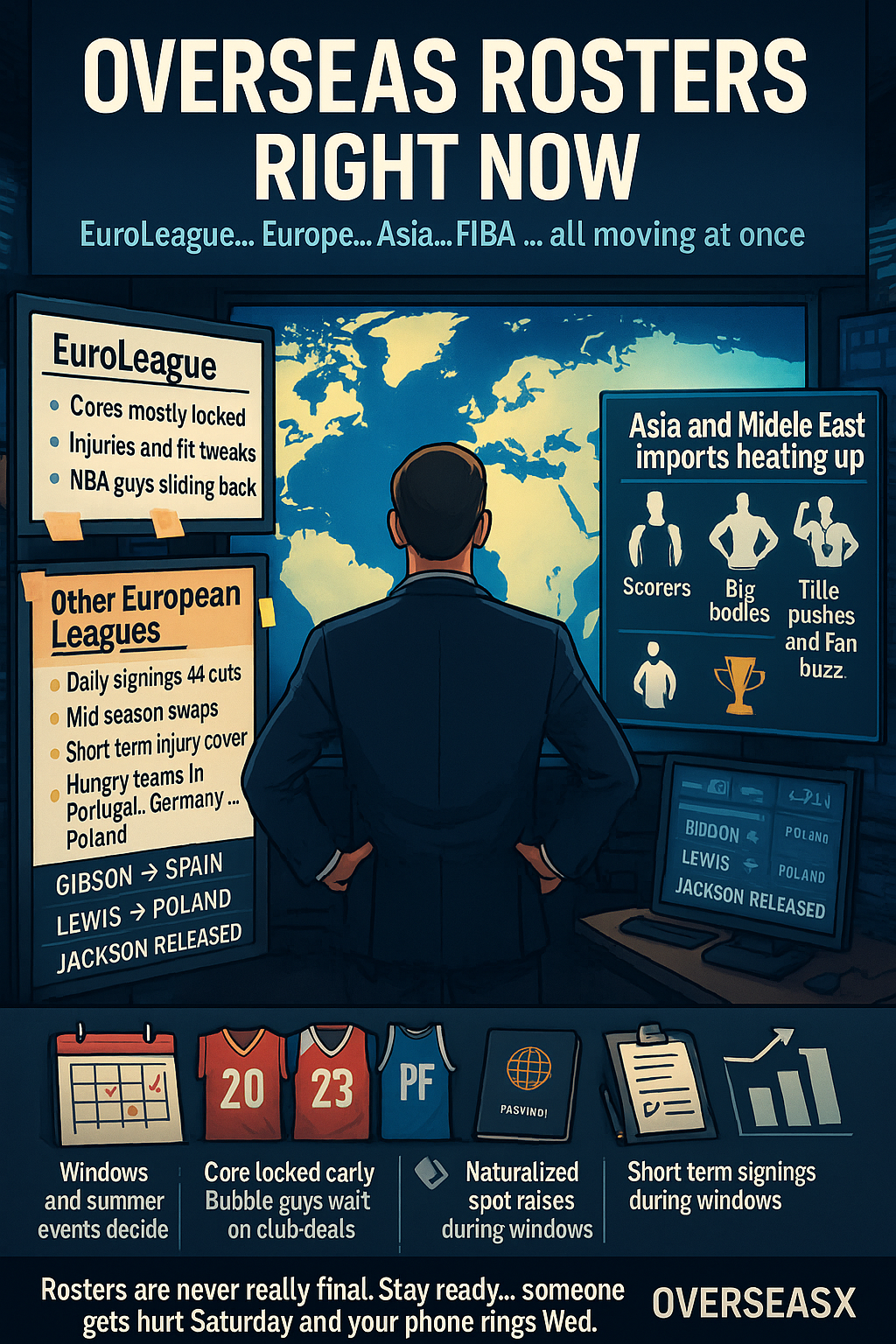
Here is the quick rundown of where overseas basketball rosters are at right now.
EuroLeague… Most Cores Set, New Teams, Still Moving
EuroLeague rosters for 2025/26 are mostly locked in. The league expanded from eighteen to twenty clubs this season, with Hapoel Tel Aviv, Valencia and Dubai BC now in the mix, and ALBA Berlin shifting over to the Basketball Champions League.
The bulk of each roster was built in the summer. EuroLeague even has its official signings and provisional rosters page live for all twenty clubs, and transfer trackers on other sites have been following every move.
You still see:
Final tweaks when someone gets hurt or a guy clearly does not fit the coach
Former NBA players sliding back over, the way you saw with buyout guys heading to Europe for bigger roles and more secure money.
A few rookies or fringe NBA guys grabbing those last twelve to fifteen minute roles, especially on the new or wild card clubs that want upside.
Coaching changes that trigger one or two extra moves, like Barcelona changing coaches in November and then rethinking parts of their rotation.
If you look at any EuroLeague transfer or transaction tracker right now, it is still getting updated, even with the regular season in full swing. That tells you teams are not finished adjusting.
Other European leagues…Constant Churn
Below EuroLeague, Europe is still chaotic in a good way.
Transaction pages that track international signings are logging new deals almost every day across Spain, France, Germany, Italy, Greece and a long list of mid tier and smaller leagues. Media in Spain and elsewhere have already done full summer recaps of how crazy the 2025 market was for EuroLeague and EuroCup teams, and that energy always trickles down into the domestic leagues.
You are seeing:
Americans and other imports leaving camp cuts or Exhibit 10 type situations in the States and landing in Europe
Mid season swaps when a club wants more scoring, more defense or more size for a playoff push
Short term injury cover deals that quietly turn into full season contracts when the player hits
Teams in leagues like Portugal, Germany and Poland picking off talented guys who sat in the States a little too long and finally decided to jump
Even in November, there are frontcourt replacements, point guard changes and second foreign spots being flipped on teams that are underperforming their budgets.
Asia and Middle East…Import Slots Heating Up
In Asia, import signings have stayed busy for the 2025/26 cycle.
Japan’s B.League is in its tenth season and has been adjusting foreign player rules and the Asian quota to bring in more high level talent from across the region, including new countries in the Asia special quota like Lebanon.
Korea’s KBL has its own system where every club has Asian imports and often a Filipino guard or wing, which keeps a steady pipeline of foreign and Asian quota guys moving in and out.
On top of that, you have:
Leagues in Japan and Korea bringing in more established pros, often bigger bodies and volume scorers, to raise the level and keep fans engaged
East Asia Super League and West Asia Super League clubs building rosters specifically to compete in those continental competitions, which means extra import signings and swaps when they need a boost for Final Eight or group play.
New money projects and traditional powers in places like the Gulf and Lebanon chasing recognizable imports to win titles and build fan buzz.
Asia basket coverage this fall has been talking about how international talent is reshaping leagues from Iran to Taiwan, which lines up with what everyone around the game is seeing.
So on the Asia and Middle East side, import slots are very real, and they are moving.
National Teams and SummerTournaments…Still Messing with Club Rosters
National team stuff is still sitting in the background of everything.
EuroBasket 2025 already happened at the end of the summer, with the final twelve man rosters set and tracked publicly, including which guys counted as the one allowed naturalized player for each national team.
FIBA has roster trackers for EuroBasket and AmeriCup that show which players have been involved in preliminary squads, qualifiers and the main tournaments, and those lists are a cheat sheet for clubs.
That does a few things to club rosters:
Players hold out for national team insurance and better club deals, especially if they were featured in EuroBasket or AmeriCup.
Clubs try to sign guys who will be in shape and showcased with their national teams, because that means free marketing and built in game rhythm.
Some teams wait to see how a player looks in national team play before locking him up for the next club season or before giving a mid season upgrade.
On top of that, the FIBA windows and summer events twist the roster game in a few specific ways:
National teams usually lock in a core months ahead, then keep two or three bubble guys fighting for the last spots. Those bubble guys often delay a club deal or push for clauses that let them leave for national team duty without drama.
There are limits on how many naturalized or dual citizens can be on a national team. So a guy who has a passport that lets him count as a local in a domestic league might be treated as the one naturalized spot for his national team. That boosts his value and leverage with both the federation and the club.
Clubs with a lot of national team players know their main guys will disappear during windows. Some bring in short term replacements which creates extra jobs and a second wave of signings. Others lean heavier on imports who are not in national team rotations.
Insurance and workload become real. A star who carries his national team through qualifiers might get a lighter role or some load management when he gets back to the club, which opens the door for another import or a young local to grab minutes and earn the next contract.
A good run with the national team can bump a player up a full tier of jobs. Someone who kills in EuroBasket or AmeriCup can go from solid import in a mid league to multiple offers from bigger clubs off one summer. Agents know this and tell their guys to be patient with club deals if they have a chance to shine with the national team.
What This Means if You are an Overseas Type Player
Again, this part is my interpretation, not an official report.
Rosters are never really final anymore. Even in November, every level from EuroLeague to smaller European leagues to Asia keeps tweaking.
Being ready on short notice matters. A lot of these signings are still, someone got hurt Saturday and we need you for Wednesday situations.
The very top European level has fewer open chairs because the cores are strong and the money is committed. The mid tier in Europe plus Asia and the Middle East are wide open and moving constantly.
The national team summer we just had created a mini wave of signings and cuts, and the next round of Continental windows and the build up to the 2027 World Cup qualifiers will do it again.
If you live in that overseas lane, your job is simple and annoying at the same time. Stay in shape, stay ready, know where the windows are, and understand that even right now, someone somewhere is about to get hurt, get cut or get a better offer. That is your opening.